
Most home care agencies don’t struggle because they lack good care. They struggle because the families who need them can’t find them, or find them and aren’t sure enough to pick up the phone. When a parent has a fall or a hospital gives a discharge date, someone starts searching that evening, and they ring the agency that looks most trustworthy first.
This guide covers home care marketing from the ground up: the strategies that bring in private enquiries, the home care advertising options worth paying for, and how to pull it all into a simple plan you can actually stick to.
Table of Contents
- Who You’re Really Marketing To
- Home Care Marketing Strategies That Bring in Private Enquiries
- Home Care Advertising: Where to Spend and What to Expect
- Home Care Digital Marketing: The Essentials
- How to Build a Home Care Marketing Plan
- Marketing for Carers as Well as Clients
- Your Home Care Marketing Questions Answered
Key Takeaways
|
Who You’re Really Marketing To
The person reading your website is rarely the person who will receive care. More often it’s a daughter or son, juggling work and family, trying to make a good decision quickly. They want three things answered fast: can you help with this situation, are you safe and trustworthy, and can you start soon.
That shapes everything else in your home care marketing. Clear service pages, honest information about how you work, and an easy way to get in touch will do more for you than clever slogans.

Home Care Marketing Strategies That Bring in Private Enquiries
These are the foundations. Get them right and every pound you later spend on advertising works harder.
1. Get Your Website Working First
Your website is where nearly every enquiry is won or lost, whether the family found you on Google, through a friend or from a leaflet. Make sure it:
- Says clearly what you do and where. Name your services and the towns you cover in the first screen.
- Shows real people. Photos of your own team build more trust than stock images.
- Makes contact easy. A visible phone number and a short enquiry form on every page.
- Works on a phone. Many families search on their mobile, often in the evening.
If your site needs more than a tidy-up, our website design for care providers page explains what a rebuild involves.

2. Be Easy to Find on Google
When families search “home care near me” or “home care in [town]”, Google shows a map with three local businesses before anything else. Your Google Business Profile decides whether you appear there. Keep it complete, add photos, post updates and ask happy families for reviews.
Beyond the map, search engine optimisation (SEO) helps your website appear for the questions families ask. Read why SEO matters for care providers for the basics.
3. Build Trust Before the First Call
Families are handing over the care of someone they love. Give them reasons to feel confident:
- Show your inspection rating. Your CQC rating in England, or your Care Inspectorate grades in Scotland, with a link to the report.
- Share reviews. Google reviews and reviews on care directories both count.
- Explain how you work. What happens at an assessment, how carers are matched, how you handle a missed visit.
See how Forest Homecare used photography, tailored messaging and website improvements to build trust online.
4. Stay Connected to Local Referrers
Not every enquiry starts online. Hospital discharge teams, social workers, GP practices, community groups and local charities all point families towards care. Regular, friendly contact keeps your agency front of mind, and community events and local awareness days are a natural way to meet people face to face.

5. Follow Up Every Enquiry Quickly
Marketing only works if enquiries turn into clients. Families often contact two or three agencies at once, and the first one to call back with a clear answer usually wins. Agree who answers enquiries, how fast, and what happens out of hours. Our guide to turning enquiries into care clients covers this in more detail.

Home Care Advertising: Where to Spend and What to Expect
Advertising puts you in front of families straight away. It works best once your website and Google listing are ready, because paid clicks still land on your site.
| Channel | Best for | How quickly it works | Watch out for |
|---|---|---|---|
| Google Ads | Families actively searching for care now | Days | Enquiries stop when spending stops |
| Facebook and Instagram ads | Reaching adult children locally, recruitment | Days to weeks | Needs good images and a clear offer |
| Local print and leaflets | Older readers, specific towns | Weeks | Hard to measure without a tracked number |
| SEO and Google Business Profile | Steady enquiries over time | Months | Slow start, but keeps working |
Google Ads for Home Care
Google Ads show your agency at the top of search results when someone types a phrase you choose, such as “live in care [town]” or “home care near me”. You pay when someone clicks. Keep your adverts to the areas you genuinely cover, send each one to the matching service page, and track calls as well as forms. Find out more about our Google Ads management for care providers.
Facebook and Instagram Ads
Social advertising lets you reach adult children in your area before they start searching, and it’s one of the most effective ways to advertise carer vacancies. Short videos of your team and real family reviews tend to work better than polished graphics. Our guide to Facebook ads for care providers goes deeper.
Home Care Advertising Ideas Beyond the Screen
- Local press and parish magazines. Still widely read by older residents and their families.
- Branded cars. Your carers are on the road every day, so their cars can carry your name and number.
- Information sessions. A talk at a library or community centre on paying for care, or on what to do after a hospital discharge.
- Printed guides. A simple “choosing home care” leaflet to leave with GP practices and community groups, where they allow it.
- Awareness days. Dementia Action Week and Carers Week give you a reason to get involved locally.

Home Care Digital Marketing: The Essentials
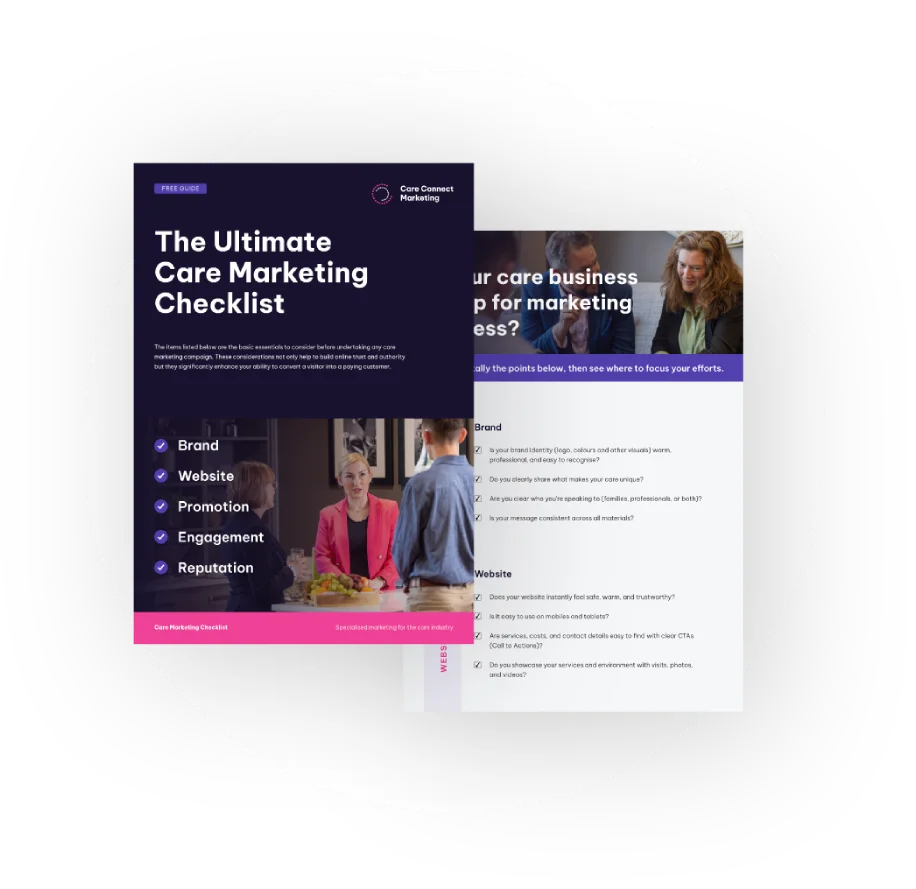
If you only have time for the basics, check these off first:
- A website with clear service pages and your coverage area
- A complete Google Business Profile with recent photos
- A steady flow of new Google reviews
- Your inspection rating shown and linked
- Enquiry forms and calls tracked, so you know where clients come from
- One social channel kept active, rather than five neglected ones
For social media, our guide to building a social media strategy for your home care agency will help you choose where to focus.
How to Build a Home Care Marketing Plan
A plan stops marketing becoming a list of things you mean to do. Keep it to one page.
- Decide what you need most. Private clients, local authority work, carers, or a mix. Each needs a different approach.
- Know your numbers. How many enquiries you get a month, where they come from, and how many become clients.
- Fix the foundations. Website, Google Business Profile and reviews, in that order.
- Choose one or two channels to grow. Pick the ones that match your goal and budget, rather than trying everything at once.
- Review monthly. Look at enquiries and clients, not just website visits, and adjust.
If you’d like help putting your plan together, our Digital Marketing Roadmap is where every client relationship starts. It looks at your business, your area and your competition, then sets out what to do first.

Marketing for Carers as Well as Clients
Most home care agencies can’t take on new clients without new carers. The same tools that bring in enquiries can help you recruit: a clear careers page, honest posts about life in your team, and targeted social adverts for live roles. Keeping recruitment in your plan means growth doesn’t stall when the enquiries arrive.
Your Home Care Marketing Questions Answered
How do I market my home care business?
Start with the basics families check first: a clear website, a complete Google Business Profile and a steady flow of reviews. Then choose one or two channels to grow, such as Google Ads for quick enquiries or SEO for steady ones, and track where each enquiry comes from so you know what’s working.
What is the best way to advertise home care services?
For families who need care now, Google Ads tend to work fastest because they reach people who are already searching. Facebook ads are better for reaching adult children locally and for recruiting carers. Local press, branded cars and community talks help in areas where many older people live.
What should a home care marketing plan include?
Your main goal (clients, carers or both), your current enquiry numbers, the foundations to fix, the one or two channels you’ll focus on, a monthly budget, and how you’ll measure results. Keep it to a page and review it every month.
How long does home care marketing take to work?
Paid advertising can bring enquiries within days of going live. SEO and reviews take longer, usually several months, but keep working without ongoing ad spend. Most agencies get the best results from a mix of both.
Is digital marketing worth it for a small home care agency?
Yes, as long as it’s focused. Most families now look online before they call, even when a friend recommended you. A small agency doesn’t need to be everywhere, just easy to find, easy to trust and easy to contact.
Should I use a marketing agency for my home care business?
It depends on your time and skills in-house. Many owners start by doing their own marketing and bring in help once they’re growing or stretched. If you do, look for someone who understands how families choose care and can show results for other care providers.