

Marketing reports can feel overwhelming; pages of charts, acronyms, and numbers that don’t always translate into clear decisions. For care providers, this is particularly challenging. You’re not selling products at scale; you’re supporting families who are making sensitive, high-stakes decisions.
Understanding which metrics matter (and which don’t) is essential for ethical, effective care marketing. This guide breaks down how to read your marketing report, using a recent performance report from our work with HQ Renovations as a real-world example.
Are you struggling to understand your marketing report? Contact the team at Care Connect today for more information on how we can help.

Why Marketing Reports Matter in the Care Sector
In the care sector, marketing is increasingly data-led. Digital channels dominate how families research care, compare providers, and make contact.
UK adults now spend over 4.5 hours online each day, with search and social platforms central to decision-making. That means your marketing performance (and how you interpret it) has a direct impact on visibility, trust, and enquiries.
A good marketing report should help you answer three simple questions:
- Are the right people finding us?
- Are they engaging with our content?
- Are they taking meaningful action?
If a report doesn’t help you answer these, it needs reframing.
Start With Your Objectives, not the Numbers
Before looking at any metric, clarify what your marketing is meant to achieve. For care providers, this usually includes:
- Increasing high-quality enquiries
- Building trust and credibility
- Improving local visibility
- Supporting long-term reputation
Metrics only matter when they connect to these goals. Without context, numbers can be misleading.
HQ Renovations: Overall Campaign Performance
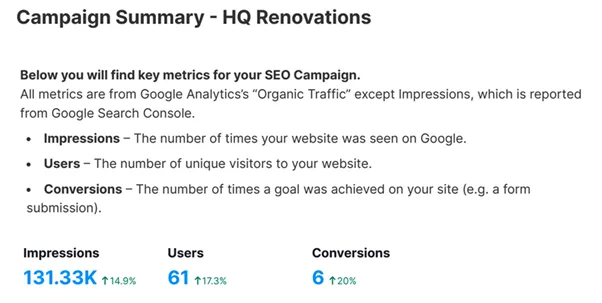
In the HQ Renovations report, overall campaign performance shows growth across all three core areas: impressions, users and conversions. Taken together, this indicates that marketing activity is aligned with business objectives. Improved visibility is leading to more visits, and more visits are leading to real outcomes.
Vanity Metrics vs Meaningful Metrics
One of the most common reporting issues is over-emphasis on vanity metrics (or numbers that look good but don’t reflect real impact).
Vanity Metrics (use with caution)
- Page views
- Social media followers
- Post likes
- Impressions
These can indicate awareness, but on their own, they don’t show whether marketing is working.
Meaningful Metrics (what to focus on)
- Enquiry conversions
- Engagement time
- Click-through rates
- Local search actions
- Cost per enquiry
In care marketing, quality matters far more than volume.
HQ Renovations: Position and Visibility Metrics Explained
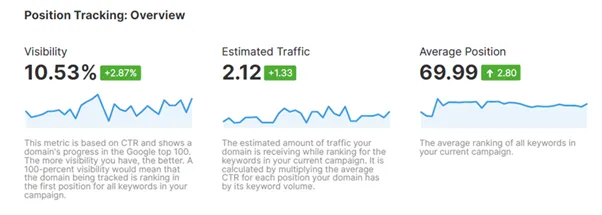
On their own, rankings and visibility are not proof of success. However, when viewed alongside rising users and conversions, these metrics show that SEO improvements are supporting real business growth, not just better-looking charts.
Website Metrics That Actually Matter
Your website is often the first serious interaction families have with your organisation. Key metrics to review include:
Engagement Time
Rather than raw traffic numbers, look at how long users stay on key pages. Longer engagement generally suggests content is relevant and reassuring.
Conversion Rate
This shows how many visitors complete an action (such as submitting a contact form or clicking to call). Even a small increase here can have a big impact on enquiries.
Top Pages by Engagement
These reveal what families care about most. Service pages, FAQs, and ‘About’ pages are often more influential than blogs.
Google remains the primary discovery tool, used by around 82% of UK adults, so understanding how people behave once they land on your site is critical.
HQ Renovations: Session Duration and Engagement
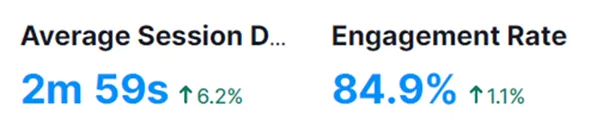
For HQ Renovations, the increase in session duration, alongside an improvement in engagement rate, indicates that visitors are more inclined to explore multiple pages, read service information, and spend time understanding the offering.
This points to stronger alignment between search intent and on-site content. Importantly, longer sessions tend to correlate with a higher likelihood of enquiry.
When users stay longer, it usually means they are comparing options, building confidence, and moving closer to a decision.
Local SEO and Google Business Profile Metrics
For most care providers, local visibility is essential. Your report should include:
- Profile views
- Calls and direction requests
- Website clicks from your Google Business Profile
- Review volume and sentiment
These metrics reflect intent, not just interest. Someone requesting directions or clicking to call is far closer to making contact than someone who simply saw an advert.
Understanding Keyword Growth
Keywords reflect the language people use when searching for services. They should be chosen based on real search intent, not what sounds good internally.
In practice, this means focusing on terms that potential clients are actually typing into Google, particularly service-based and location-specific searches. Keywords should be naturally integrated into key pages such as service descriptions, headings, and supporting content, rather than forced into copy.
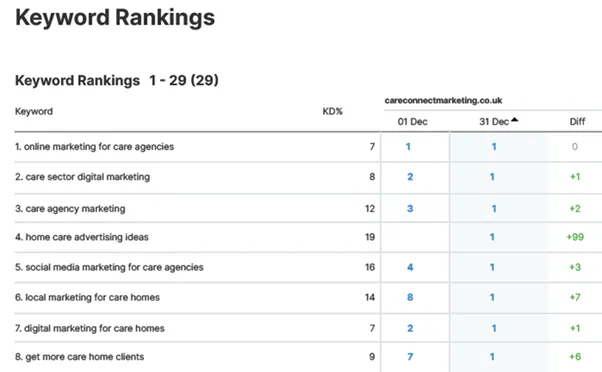
Care Connect’s own report shows improvements in keyword rankings across positions 1 through 99. This indicates growth not only in top-ranking keywords but also in emerging search terms.
This matters because it shows the site is expanding its overall keyword footprint. Stronger coverage across a wider range of terms supports both immediate visibility and long-term SEO performance, rather than relying on a small number of high-ranking keywords.
Organic Traffic Performance
Organic traffic shows how effectively your website is being discovered through search and how users behave once they arrive. It is one of the clearest indicators of long-term marketing health, as it reflects sustained visibility rather than short-term campaign activity.
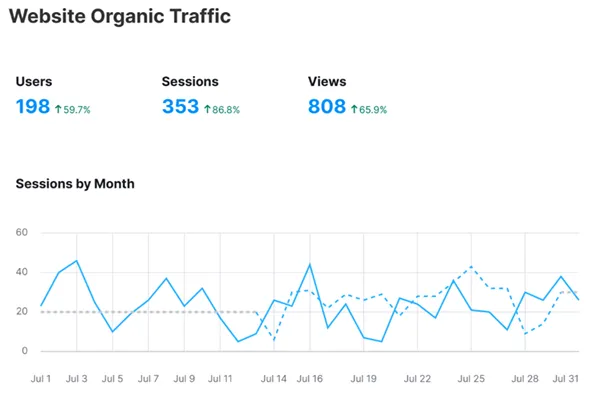
For HQ Renovations, the organic traffic data shows growth across multiple metrics, not just a single spike.
Increasing user counts indicate more people are finding the site through relevant searches. Rising session counts suggest visitors are returning to or exploring the site more than once, while higher page views indicate deeper engagement with content.
What matters most is the combination of these signals. When users, sessions, and page views all increase together, it suggests that SEO improvements are attracting the right audience and encouraging meaningful interaction
Channels Performance: Where Growth is Coming From
Channel performance shows where your website traffic is coming from and how people are finding your business. More importantly, it helps you understand which marketing activities are actually driving growth, rather than just generating noise.
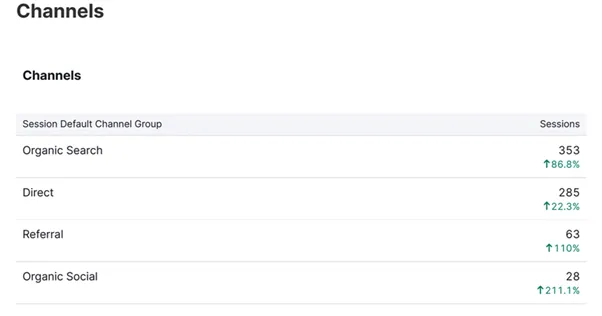
In the HQ Renovations report, growth is spread across multiple channels, which is a strong indicator of healthy, sustainable marketing performance. When channel growth is balanced like this, it typically leads to more stable enquiry levels and better long-term performance.
Acquisition by Channel: Attracting new Users
Acquisition data focuses specifically on new users. While channel performance shows overall traffic trends, acquisition tells you which channels are actively bringing new people to your website for the first time.
This distinction matters because growth depends on both attracting new prospects and re-engaging existing ones.
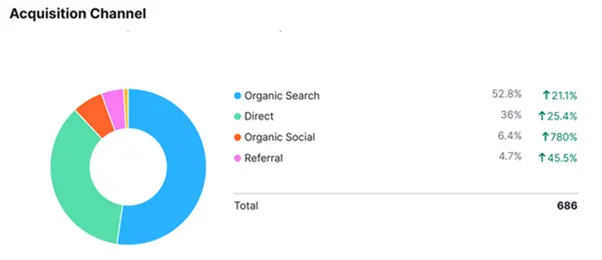
In the HQ Renovations report, acquisition data shows strong performance across multiple sources, indicating effective discovery as well as growing brand presence.
When acquisition grows across multiple channels, it reduces dependency on any single source and supports long-term, sustainable pipeline growth.
Social Media Metrics That Support Trust
Social media performance in care should be assessed differently from retail or entertainment brands.
Useful metrics:
- Saves and shares
- Comments (quality over quantity)
- Profile visits
- Website clicks
These actions indicate trust and interest. By contrast, likes alone tell you very little.
Data shows that platforms like Facebook, WhatsApp and YouTube are used by over 90% of UK online adults. Your reporting should focus on whether social content supports reassurance and connection, not just reach.
Reporting on Accessibility and Ethics
Increasingly, good marketing reports also reflect how marketing is delivered.
Metrics to consider include:
- Mobile usability
- Page load speed
- Bounce rate on key information pages
Accessibility issues can silently undermine performance. With 16.1 million disabled people in the UK, inaccessible websites risk excluding a significant portion of your audience.
Ethical marketing means ensuring your data reflects inclusive, respectful communication, not just growth.
How Often Should you Review Reports?
Monthly reporting is usually sufficient for:
- Website performance
- Paid campaigns
- Social engagement
Quarterly reviews are useful for:
- Trend analysis
- Strategic adjustments
- Budget allocation
More frequent reporting can create noise rather than clarity, especially in care where decision cycles are longer.
Questions you Should be Asking Your Marketing Partner
A good report should prompt discussion, not confusion. Useful questions include:
- Which metrics link directly to enquiries?
- What’s improving, and why?
- Where are people dropping off?
- What should we test next?
If reports focus only on activity, not outcomes, they’re missing the point.
Making Reports Work for you
You don’t need to understand every technical detail. You need to understand what’s working, what isn’t, and what to do next.
Clear reporting supports better decisions, ethical marketing, and sustainable growth; all are essential in the care sector.
Turning Insight Into Action
Marketing reports are not performance scorecards; they’re decision-making tools. When you focus on the right metrics, reports become clearer, more useful, and far less intimidating.
For care providers, the goal isn’t to chase numbers. It’s to understand behaviour, build trust, and support families at the moments that matter most.